Thursday, July 30, 2026 | 9 AM - 5:30 PM
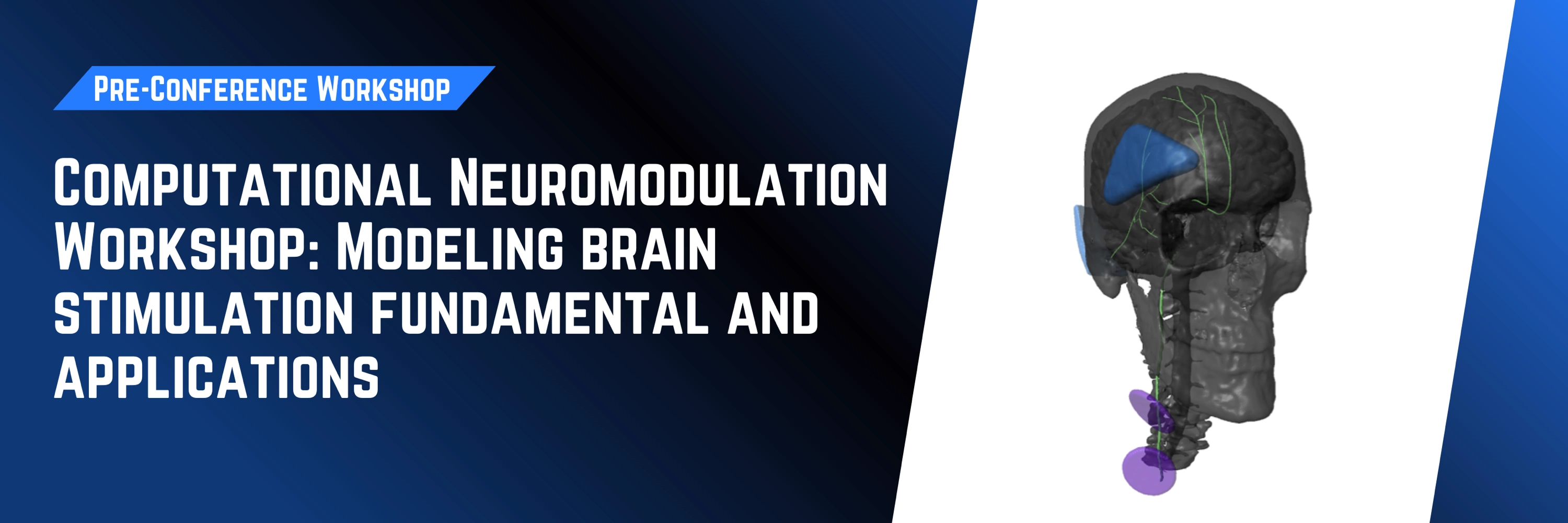
Chairs: Aman Aberra (Dartmouth) & Sergey Makaroff (WPI/MGH)This full day workshop provides a comprehensive perspective on computer driven analysis and design for neuromodulation. Topics covered span model creation and image segmentation for current flow predictions, as well as simulation of neural activity at the single neuron and network levels. The full day intensive workshop is structured to be open to individuals from diverse backgrounds, providing novices a broad perspective on modeling of neuromodulation and providing experts with precise methodological insights. The workshop will be relevant to individuals with limited technical background in modeling who are interested in learning the fundamental theory necessary to apply these models and how to access simple modeling tools. It will also be relevant to experienced engineers who want to learn the most advanced techniques from leaders in the field. The workshop will cover critical aspects of the biophysics and neural mechanisms of stimulation, including the definition and quantification of dose, the impact of temporal waveform, neuronal stimulation threshold, modulation of information processing, and plasticity. Workshop talks will include demonstrations of modeling workflow and technique and time for discussion to address specific attendees’ questions and concerns. The scope of the workshop is intended to be relevant for all forms of electromagnetic stimulation including non-invasive (TMS, tDCS, tACS, interferential stimulation) and invasive approaches (DBS, SCS, PNS, VNS, etc.), as well as other established neuromodulation modalities like focused ultrasound. Attendees will leave the workshop with a deep and unique perspective on how the most accurate and detailed computational models of neuromodulation are developed and used.
What is the overall purpose of computational models in neuromodulation study and design? What are the best steps (pipeline) in computational models? What simple and professional tools are available for computational models? What determines the distribution of electrical current flow in tissue and which brain regions are targeted? How does applied current alter neuronal and network activity? How can individualized models be developed from imaging data, including tissue segmentation? How can models be used to optimize and personalize stimulation? How should we select the appropriate model and level of detail for specific goals? What are the frontiers of what’s known and emerging approaches in computational neuromodulation?
Individuals who attend the entire workshop will, upon request, receive a certificate of completion. There will be a lunch break with included box lunch for attendees (11:55 PM - 12:55 PM). There are no qualifications required for attendance. Attendees are encouraged to bring their own laptop, but this is not required. There are no reading materials before the workshop and no software to install before the workshop.
Please note that this program is currently in development.
| Time | Session |
|---|---|
| 9:00 – 9:10 | Aman Aberra (Dartmouth) and Sergey Makaroff (WPI/MGH) – Introduction |
| 9:10 – 9:40 | Boshuo Wang (Duke) – Micro to Mesoscale Tissue Modeling |
| 9:40 – 10:10 | Aman Aberra (Dartmouth) – Biophysical Neuron Modeling: from Electric Fields to Neural response |
| 10:10 – 10:25 | Break |
| 10:25 – 10:55 | Alexander Opitz (U Minn) – Multiscale Electric Fields and Neural Network Dynamics for Transcranial Magnetic and Electrical Stimulation |
| 10:55 – 11:25 | Esra Neufeld (IT’IS) – Precision Noninvasive Brain Stimulation |
| 11:25 – 11:55 | Sergey Makaroff (WPI/MGH) – Beyond FEM: High-resolution, Microscopic Brain Modeling |
| 11:55 – 12:55 | Lunch (box lunch, included) |
| 12:55 – 1:25 | Cameron McIntyre (Duke) – Structural Connectome-guided Modeling of Deep Brain Stimulation |
| 1:25 – 1:55 | Nicole Pelot (Duke) – Modeling and Experimental Validation of Peripheral and Vagus Nerve Stimulation |
| 1:55 – 2:25 | Théo Lemaire (NYU) – Cellular and network modeling of ultrasound neuromodulation |
| 2:25 – 2:40 | Break |
| 2:40 – 3:00 | Costas Anastassiou (Cedars-Sinai Medical Center) – Cell Class-specific Electric Field Entrainment of Neural Activity |
| 3:00 – 3:20 | Konstantin Weise (MPI) – Statistical Modeling of Neural Responses to Brain Stimulation |
| 3:20 – 3:40 | Luis Gomez (Purdue) – Bidomain BEM Modeling of Neural Stimulation |
| 3:40 – 4:00 | Denys Nikolayev (CNRS) – Modeling high-frequency electromagnetic radiation for neural interface technologies |
| 4:00 – 4:20 | Break |
| 4:20 – 5:20 | Research highlights: Novel Applications of Computational Modeling to Understand and Optimize Neuromodulation |
| 5:20 – 5:25 | Closing Remarks |
Co-sponsored by the Brain and Human Body Modeling Conference – From Fast and Accurate Computational Modeling to Clinical Practice