Thursday, July 30, 2026 | 7:30 AM - 6:00 PM
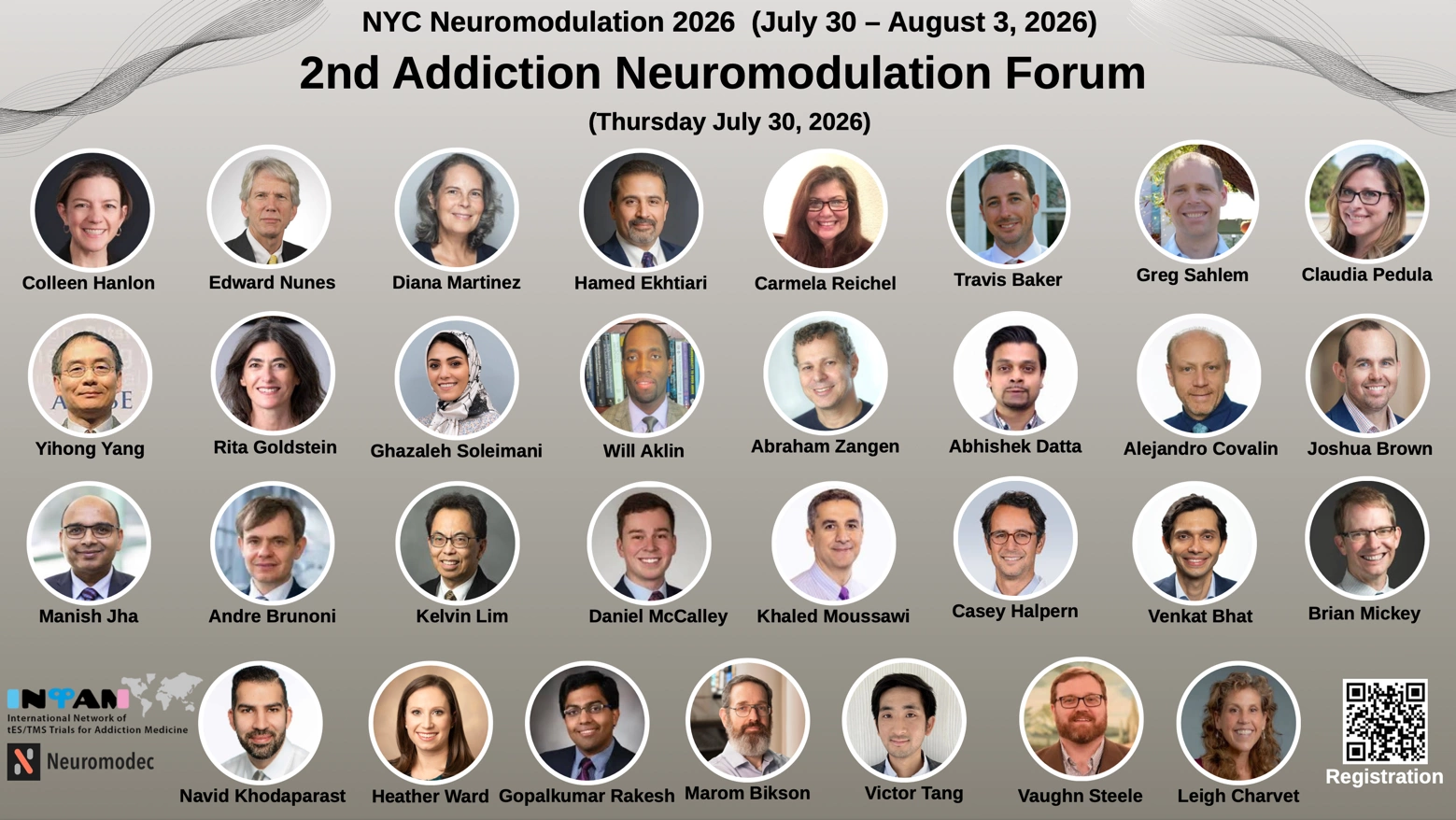
Forum Chair: Marom Bikson, PhD Forum Scientific Secretary: Hamed Ekhtiari, MD, PhD
The 2nd Addiction Neuromodulation Forum, held as a pre-conference event of NYC Neuromodulation 2026, brings together leading scientists, clinicians, regulators, funders, and industry partners to critically assess whether neuromodulation for substance use disorders (SUD) is ready to transition from promising experimental interventions to scalable, evidence-based treatments. The meeting will cover the full translational continuum—from circuit-level mechanisms and targeting biomarkers to accelerated protocols, augmentation strategies, regulatory pathways, and real-world implementation in addiction care settings. Emphasis will be placed on what evidence is sufficient, what gaps remain, and how to align science, regulation, and industry to responsibly accelerate impact. Special attention will be given to personalized and precision approaches, special populations and comorbidities, safety and acceptability, and models for accessibility and scalability, including home-based and community-integrated neuromodulation. This forum is designed not only to review the state of the science, but to shape the next generation of trials, funding priorities, and regulatory strategies in addiction neuromodulation.
Meeting Highlights: Why Attend?
1. A Reality Check on the Evidence
2. Frontiers That Matter for the Next 5 Years
3. Optimization Is the New Innovation
4. Direct Dialogue with Decision-Makers
5. Implementation, Not Just Efficacy
6. A Strategic Networking Environment
| Time | Session |
|---|---|
| 7:30 AM | Doors Open and Registration |
| 8:00 - 8:30 AM | Morning Social, Reception and Coffee |
| 8:30 - 9:30 AM |
Panel 1: Current Level of Evidence for Brain Stimulation in Substance Use Disorder (SUD) Treatment: What Else is Needed for the Prime Time? Chair: Hamed Ekhtiari Speakers: Colleen Hanlon, Edward Nunes, Diana Martinez, Andre Brunoni Topic Highlights:
|
| 9:30 - 10:30 AM |
Panel 2: Frontiers in Cortical Stimulation for Addiction Treatment: From Mechanism to Impact Chair: Travis Baker Travis Baker: Modulating Cingulate Cortex in Substance Use Disorders: What Works and What Doesn't Work. Greg Sahlem: Selectively Modulating SUD Circuitry Using Personalized rTMS Targeting and Pharmacologic Strategies Rita Z Goldstein: Brain-to-Brain Neurofeedback during a Naturalistic Dynamic Stimulus to Reduce Craving in Heroin Addiction Claudia Padula: Gender Considerations in Addiction Neuromodulation Yihong Yang: Cross Species Targeting Biomarkers for Addiction Neuromodulation |
| 10:30 - 11:00 AM | Coffee Break |
| 11:00 AM - 12:00 PM |
Panel 3: Funding and Regulatory Agencies and Industry Chairs: Marom Bikson and Hamed Ekhtiari Current NIDA and NIAAA funding Opportunities: Will Aklin, Carmela Reichel, and NIAAA PO Other Federal Grant Opportunities: ARPA-H and PCORI Working with FDA: Both from FDA and Industry Perspectives Industry Perspectives and Plans:
|
| 12:00 - 1:00 PM | Lunch Break |
| 1:00 - 2:30 PM |
Panel 4: Optimization and Augmentation in Addiction Neuromodulation Chair: Joshua Brown Medication Augmentation: Joshua Brown Accelerated Protocols: Manish Jha Behavioral Augmentation: Kelvin Lim Cognitive Augmentation: Rita Z Goldstein Priming Augmentation: Abraham Zangen Individualized Targeting: Daniel McCalley and Ghazaleh Soleimani |
| 2:30 - 3:30 PM |
Panel 5: Frontiers in Sub-Cortical and Peripheral Stimulation for Addiction Treatment: From Mechanism to Impact Chairs: Khaled Moussawi and Brian Mickey tFUS: Khaled Moussawi and Brian Mickey DBS: Casey Halpern TI: Venkat Bhat Transcutaneous Auricular Neurostimulation (tAN): Navid Khodaparast |
| 3:30 - 4:00 PM | Coffee Break |
| 4:00 - 4:45 PM |
Panel 6: Special Populations and Comorbidities in People with SUD Chair: Heather Ward Smoking in People living with Schizophrenia: Heather Ward People Living with HIV and Cancer Survivors: Gopalkumar Rakesh TMS for Psychiatric Comorbidities in people with SUD: Victor Tang |
| 4:45 - 5:30 PM |
Panel 7: Safety, Tolerability, Accessibility, Scalability and Acceptability of SUD in Addiction Clinics Chair: Heather Ward Home-based neuromodulation in SUD: tDCS for CUD: Leigh Charvet TMS safety and tolerability in people with SUD: Vaughn Steele Group discussion: Heather Ward: Boots on the Ground: Challenges of Implementation of Neuromodulation as a Part of Addiction Recovery Care |
| 5:30 - 6:00 PM | Final Discussion and Wrap Up |
| 6:00 - 8:00 PM | Conference Social Event (Baylander Steel Beach - West Harlem Piers) |